



The Master's Lesson.
by Ada Ruth Habershon
Some years ago, I used greatly to enjoy some sketching lessons I was privileged to have from a well-known water-colour artist, Mr. Paul J. Naftel. It was a special treat to go out with him and a few of his pupils for a day's sketching. Each one of us would try to paint something of the landscape from our given point of view, whether the spot chosen were amongst the trees in Kensington Gardens or by the river side. His method of teaching was to show his pupils how the sketch should be made. He did not come and stand behind us and say, "That is not properly drawn, you must rub it out," or, "This colour is not good—you want more grey here," or, "That tree is too green." No, he went round from one to another, and in turn, took their place and worked on the sketch.
Some of the pupils were too nervous to do much, they knew he painted so beautifully, and they did not like to show how badly they did it, nor did they want to spoil their picture; so, after drawing the outline, they would begin very timidly to put in a little touch of colour here or a faint wash there, and when the master came round, there was not much on the paper. But I found out a valuable secret on those delightful expeditions. I used to work as hard as ever I could, and as quickly, taking care to do my best, and putting in as much as possible, even though I could not do it well, and often made a great many mistakes.
How well I remember one such sketch. I have it still. The old Kew Bridge in the distance, the grey river reflecting the cloudy sky, the willow tree overhanging the shore, and an old barge lying on the wet mud. I had tried to put in all these things, but I was so dissatisfied with what I had done. It looked so different from the real picture that I was trying to copy. And then the master came to me, and, taking my place, he dipped the brush in my little can of water, and with a skillful hand, began to wash out this bit, and to soften that; and, taking some fresh colour from the paint-box, he quickly touched in the scene afresh. And now the reflections in the river looked so real, the willow had just the right blue sheen upon it, the flickering lights and shades appeared on the mud, and lo, out of my poor attempt, the master had made a picture.
And this was the secret I learned—washed-out mistakes make a beautiful foundation for a master hand to work upon.
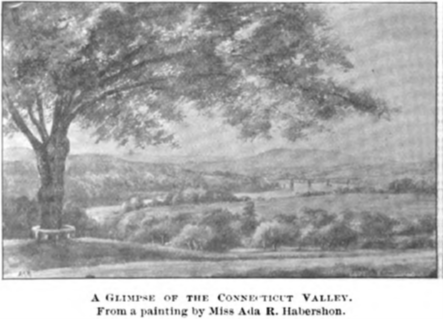
Is it necessary to explain my parable? How marvellously God works in the lives of His children. He makes even our mistakes a means for displaying His wonder-working skill.
The miracle of His over-ruling power in the lives of all His own is beyond our understanding. We scarcely realize what a stupendous statement it is when we repeat the familiar words, "For we know that all things work together for good to them that love God." The life of every one of His people is the object of His care. It is not the special privilege of some spiritual and experienced Christians. It is true for all "who are called according to His purpose," and it includes "all things."
What a marvel of Divine skill that each individual life should be ordered separately and yet should fit in with the lives of all other fellow believers. And it is not only true when we walk according to His plan. Even the mistakes and sins of God's people are made to work together for good.
How tenderly He washes out the mistakes if we bring the blurred and blotted picture to Him! And when He takes the brush in His hand, we learn that the washed-out mistakes make a wonderful foundation for the Master Hand to work upon. Have we not proved it so? It is beautiful indeed to see the picture grow. Have we not delighted to watch it in the lives of those who have been yielded to Him?
We must, however, let Him do it. How much I should have lost when I was sketching that day by the river-side if I had said, "I have spoilt my sketch; I will not let the master see it." Supposing I had hidden it when he came to my place, he would never have been able to make the picture. But by putting it into his hand, with all the. failures and mistakes, I was rewarded by watching my picture grow into his picture.
God takes great delight in making pictures out of the lives of His children. "The steps of a good man are ordered by the Lord, and He delighteth in his way." We read elsewhere that "there is none that doeth good, no, not one," so the "good man" must be one who knows what it is to "taste and see that the Lord is good," one whose sins have been forgiven for His Name's sake. To order the life of such an one is God's delight.
There will be a marvellous exhibition in the Royal Academy of Heaven when the pictures of the Divine Artist are brought together and displayed, "that in the ages to come, He might shew the exceeding riches of His grace, in His kindness toward us through Christ Jesus.' A. R. Habershon.
“Our Hope” 1915
