




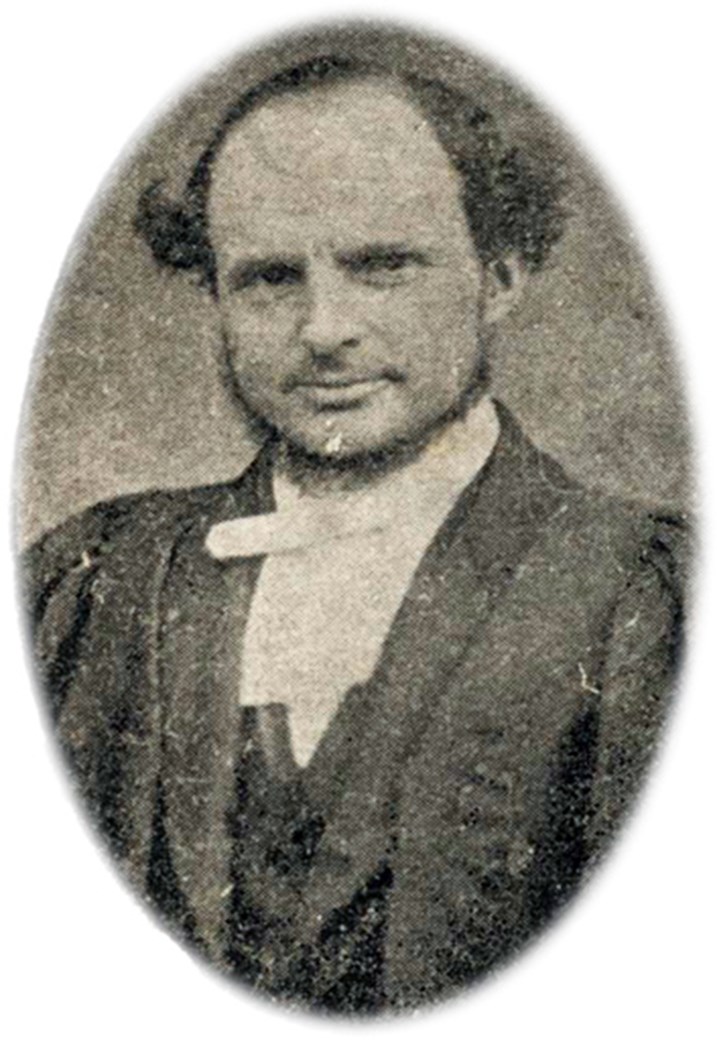
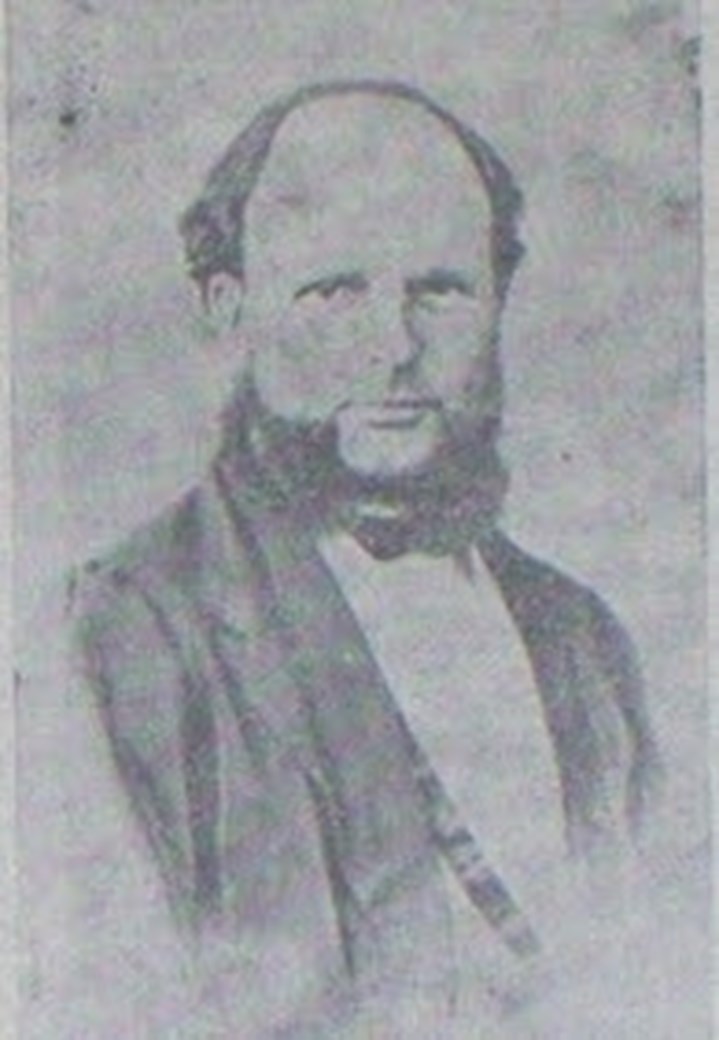
From https://movimentodosirmaos.blogspot.com/p/richard-holden.html
Richard Holden was born in August 1828 in Dundee, Scotland, the son of an Anglican couple, and was raised in the principles of the Gospel.
He said that until the age of 21, he lived oblivious to the things of God, preferring to live alone.
Two months after turning 21 (1849), he caught a severe cold that attacked his chest, and he began to think: "Who knows if, with this illness, I will become consumptive and die?" This thought distressed him, but upon recovering, he quickly forgot about it and remained indifferent, he recounted.
One winter Sunday afternoon, he went into his father's library to choose a book to take to a cabin in the hills where he used to retreat alone to read. On the shelf, two works caught his eye – one was by Shakespeare, the celebrated poet, and the other was Dr. Dwight's "Theology." He hesitated, but decided to take the second one to see what it contained.
He recounts in "Memories of the Past" that the volume began with a preliminary discourse on the "Existence of God." He further stated: "The reading of this discourse impressed me so much that it resulted in my conversion! Suddenly , I felt myself in the presence of a God who truly exists, a Being to whom I would have to give an account of my actions! My previous state of indifference was transformed into an uncontainable longing to obtain salvation! My soul delighted in having discovered that, in the Glory of God, there truly exists a LIVING MAN, the Son of the Eternal God; that this Son of God had taken human form, lived here, suffered, died, and finally resurrected and ascended to the throne of His Father in heaven – all this for the purpose of saving sinners! How different my ideas about 'human greatness' were now!"
He was in Brazil in 1851 as a merchant, which is when he began learning the Portuguese language.
In 1856, he went to Gambier, Ohio, United States, where he enrolled in the Theological Seminary, affiliated with Kenyon College. He graduated in 1859.
During his time in the United States, he translated several religious writings into Portuguese, including "The Book of Common Prayer" and various traditional Anglo-American hymns. Having graduated from seminary, Holden offered to work in Brazil and was accepted by the United States Board of Episcopal Missions and the American Bible Society.
Before coming to Brazil, he went to Europe to visit his father, and in November 1860, he embarked from Liverpool bound for Belém do Pará. He brought with him a copy of "Brazil and the Brazilians" by Fletcher, and a number of Bibles.
He founded a church in Belém, since the American captain Robert Nesbitt had already begun distributing Bibles in the city. He used the local press to spread the Gospel and ended up becoming involved in a controversy with the Roman Catholic bishop of Belém, Dom Antônio de Macedo Costa. Until 1861, he made four trips, traveling through the Amazon Basin, distributing Bibles and evangelical pamphlets in riverside villages and towns. He even went to Peru, taking his remaining stock of Bibles in Spanish and Portuguese.
In 1862, he moved to Salvador, Bahia, where he joined Thomas Gallart. They suffered persecution from the Roman Catholic clergy and even death threats, requiring the American consul to intervene with the authorities on behalf of Holden and Gallart, including the President of the Province. His evangelization efforts were unsuccessful.
In 1864 he came into conflict with the Mission Department of the American Episcopal Church, which subsidized him, and separated from it. In that same year, he received an invitation from Robert Reid Kalley to come to Rio de Janeiro to succeed him as pastor of the "Igreja Evangélica Fluminense" (Fluminense Evangelical Church). He arrived in Rio on February 18, 1865, and on March 3 of that year he was elected co-pastor, in cooperation with Dr. Kalley.
In 1868 the Kalley couple traveled to England, and Mr. Holden remained alone, in the pastorate of the church, until the couple's return on June 18, 1871.
On July 8, 1871, Holden returned to Europe, where he sympathized with the Brethren Movement.
In 1876, in Portugal, he published the first edition of the hymnbook "Hinos e Cânticos" (Hymns and Songs), which contains several hymns of his own authorship and translation. In 1877, he inaugurated the "Casa de Oração" ("House of Prayer" - Meeting Hall) in the Amoreiras neighborhood of Lisbon.
In 1878, in Brazil, the first meeting on common ground in the style of the "brethren" was recorded at Rua da América, 4, in the city of Rio de Janeiro, and on July 10 of the following year (1879) Holden arrived in Brazil to organize this assembly. At this time, the assembly that had previously met on Rua da América now met in a room at Rua de São Pedro, 315 (present-day Praça da República). This house was demolished when Avenida Presidente Vargas was opened.
On November 18, 1879, Mr. Holden embarked back to Lisbon, after staying in Rio for 4 months and 8 days. He never returned to Brazil.
He was married to Caterina Holden, and they had only one child, Ernest Holden.
On July 17, 1886, at the age of 58, Holden died in Lisbon and was buried in the city's Protestant cemetery.
-----------------------------------------------------------------------------------------------------------------------------------------------------------------
From https://www.stempublishing.com/hymns/biographies/holden.html
Notes from the "History of the Brethren" by Napoleon Noel:
Richard Holden was formerly an Anglican clergyman. He went out to Portugal in the Lord's work. His letters to his mother giving reasons for leaving the Church of England had a wide circulation. He wrote the hymn "Lord of Glory we adore Thee". His departure to be with Christ is an example of the faithfulness and sustaining grace of God to those who obey His call to serve Him in foreign lands, and of His presence with and rich blessing upon them.
Mrs. Holden realized this when she wrote from near Lisbon, Aug. 24th. 1886:
"Yes, my dear husband is at home now with the One he loved so well, waiting with Him until He come. It was at first a trial that my dear husband left me. This is almost the only time I can remember in all the happy years since the Lord gave us to each other, he left me without saying 'good-bye'. There was nothing of death or sadness in that sick room; he was so happy, so cheerful. All who came to say 'Good-bye' — the dear saints and many others — left thinking he would yet be among them, he looked so bright. The doctor alone, gave me no hope, and oh he was so kind! My dear husband was so fond of him. 'Doctor', he said, 'a death bed is not the time to seek the Lord. What would I do if I had to come to Him in all this pain? No, thank God, it is all bright, all joy. Thirty eight years I have known the Lord and I never had a doubt of my soul's salvation. Now it is all joy to go. Not even my wife, dearly as I love her, or my boy can hold me back. It is all bright — all joy'. Someone said, 'You are going to get your crown of glory'. 'Not the crown, not the crown' he said quickly 'the One who gives it'. When I asked him if he had any wish about Ernest or myself, brightly he said, 'Not a wish, not a care. My wife and my boy are both in my Father's hand; He will guide. I would not wish it otherwise. A little while, dear wife, and God with you all the way'. He had such perfect rest in God about everything, such trust in the Father's heart, and you know how dear the saints in Lisbon were to him; but God's care for them was enough. In death he was allowed once more the privilege of witnessing for the truth, so dear to him in life. They refused to have him buried in the English cemetery, as our views were different, and he could not be buried there without a service from an ordained clergyman. Martiers then thought that he had got it all arranged for Playares, and we went there on Monday, Aug. 19th. 1886. All the dear saints and many others met us at the cemetery, and a quiet blessed time we had, beginning with the Portuguese hymn, 'Glory unto Jesus be, etc' then Tenas prayed with great power. Martiers read 1 Cor. 15. A praised and prayed. Tenas said a few precious words and we sang the hymn 'Asleep in Jesus, etc.' Mr. Hall then gave out the lovely Portuguese hymn, one of his own, 'Thou art my rest, Lord Jesus'. The coffin was open all the time — this is the custom here — and you had only to turn your eyes to his happy face and know how true were the words he had written. I had to leave them, as I was sick; but Mr. Hall said it was the most touching sight he had ever witnessed; and the dear saints went forward in their deep, deep grief and kissed him. Then came the order that he could not be buried there; so, twice refused a resting place, the coffin was taken back to the carriage and buried in the little cemetery outside the gate. [Note Ex. 33:7; Heb. 13:10-14]. 'The Lord Himself shall descend from heaven, etc. and so shall we ever be with the Lord'. (1 Thess. 4). With my loving thanks to each one for their love and sympathy, and the earnest desire that Christ be everything with us until He comes, very affectionately, Yours in Him", signed Kate Holden.
From "Reminiscences" by Stuart E. McNair.
In 1891 I answered an advertisement for an engineering draughtsman wanted in Lisbon, and obtained the situation, boarding there with the widow of the well-known Bible teacher, Richard Holden, for the next five years. To live with such a Christian as Mrs. Holden was an education in itself, and from her I learnt valuable lessons in the spiritual life. She was a believer, tried and tested in almost every possible way, but always serenely cheerful, so that the neighbour opposite once asked her what was the secret of her happiness. She was tireless in Christian service, in visiting, holding meetings for young people and also for the neighbouring ragged children. In spite of her piety she must have had some sense of humour. An English friend commented once on a particularly ragged little boy in her class, and remarked that his trousers were badly torn. "Do you call them trousers?" asked Mrs. Holden "I call it an apron".
Mr. Holden wrote a valuable booklet called "Ministry of the Word — eldership — and the Lord's Supper", an earnest loving word from an ex-clergyman to some of his former colleagues. He began the booklet with "Dear brothers in the Lord". In a footnote in his booklet, Mr. Holden wrote that he had candidly and fairly weighed the pretensions of the Irvingites (the speaking with tongues and miracles of that day) as to apostles, etc. before he gathered to the Name of the Lord among "Brethren". He found the Irvingite claims empty and groundless.
Mr. Holden's hymn in 'Spiritual Songs' is number 134, "Lord of Glory we adore Thee", an excellent hymn extolling the glories of the Lord Jesus.
Got a biographical article from wikipedia in Portuguese. All you need to do is translate it !
Richard Holden Origem: Wikipédia, a enciclopédia livre. Richard Holden (Dundee, 1828 — Lisboa, janeiro de 1886) foi um missionário escocês, um dos pioneiros do Protestantismo no Brasil.[1] Era filho de um casal anglicano. Converteu-se à Igreja Episcopal aos 21 anos, depois de passar uma experiência mística e a cura de uma doença. Esteve no Brasil em 1851 como comerciante e foi quando iniciou a aprender português. Estudou teologia e português em Ohio, nos Estados Unidos. Traduziu o Livro de Oração Comum e muitos hinos tradicionais anglo-americanos para o português. O Departamento de Missão da Igreja Episcopal e a Sociedade Bíblica Americana o enviaram ao Brasil em 1860. Fundou uma capela em Belém do Pará em 1860, aproveitando do fato que o capitão americano Robert Nesbitt, já havia iniciado a distribuição de bíblias na cidade. Usava a imprensa local para difundir o evangelho e, apoiado por certos políticos brasileiros e com líderes maçónicos, colocou-o na vanguarda dos primeiros estágios da Questão Religiosa e acabou por se envolver em uma polêmica com bispo católico romano de Belém, Dom Antônio de Macedo Costa. Viajou pela bacia do Amazonas, distribuindo Bíblias e panfletos evangélicos nas vilas e cidades ribeirinhas. Em 1862 mudou-se para Salvador, na Bahia, onde sofreu três atentados de morte. Polêmico, entrou em conflito com o Departamento de Missão da Igreja Episcopal Americana, que o subsidiava. Em 1864, outro missionário, Dr. Robert Kalley convidou-o para vir ao Rio de Janeiro, para sucedê-lo como pastor da Igreja Evangélica Fluminense, assumindo o cargo de pastor-auxiliar em fevereiro de 1865. Holden começou a aderir algumas doutrinas darbistas, como o Dispensacionalismo e a organização eclesiástica de total autonomia da igreja local, que deveria ser presidida por um colégio de anciãos leigos. Isto gerou um conflito na Igreja Evangélica Fluminense e, em 1871, Holden deixou o Rio rumo a Inglaterra e Portugal. Holden iniciou a primeira Casa de Oração – Irmãos em Portugal em 1871. Em 1876 editou um hinário Hinos e Cânticos Espirituaes em português e, em 1877, inaugurou o prédio da Assembleia dos Irmãos de Amoreira, bairro de Lisboa. Em 1878 um grupo de 26 pessoas oriundas da Igreja Evangélica Fluminense, fundaram a primeira Casa de Oração – Irmãos. Em julho do ano seguinte Holden veio ao Brasil para organizar esta igreja. Holden faleceu em Lisboa, sendo enterrado no cemitério protestante da cidade.
Referências Ir para cima ↑ Braga, Henrique Rosa Fernandes (2004). Ensaios Históricos do Protestantismo Brasileiro. Rio de Janeiro: Livraria Kosmos Editora. pp. Página 324. Consultado em 24 de novembro de 2017
In addition, according to http://www.gracelifebiblechurch.com/PastorsPen/2012STFSC/FOF3%20Advancements%20in%20Pauline%20Truth%20through%201870,%20Part%202.pdf , he has written a very interesting tract on dispensationalism <<Holden, Richard. The Mystery, the Special Mission of the Apostle Paul, the Key to the Present Dispensation. Reprinted as “The Mystery: Ephesians 3” in The Christian’s Friend, in 1876. http://www.stempublishing.com/magazines/cf/1876/The-Mystery.html>>
It would be interesting to see an original version of this dispensational tract, which was issued by W H Broom in 1870.
Here are 7 different pamphlets produced by Richard Holden which are in the CBA. (duplicate titles are omitted)
1-HOLDEN (Richard) Corinth and sects. [Photographic reprint.] Morganville, NJ, Present Truth Publishers, [c. 1987]. 22p. 6". 14190
2-HOLDEN (Richard) Eternal life, as manifested in Jesus and imparted to the believer: its nature, accompaniments, and issues. London, W.H. Broom, 1876. 63p. 6.5". (GC41803/KR895) 5616,(1)
3-HOLDEN (Richard) Genuine belief leads to action: extracts from letters written by Richard Holden. London, Central Bible Truth Depot, [n.d.] 12p. 5.5". 12095,(14)
4-HOLDEN (Richard) A letter on order in preaching. [Signed]("R.H.,")[i.e. R.Holden.] (London, W.H.Broom,)[n.d.] 7+[1]p. 7". (GC53735) 10834
5-HOLDEN (Richard) Ministry of the word, eldership, and the Lord's Supper: an earnest, loving word from an ex-clergyman to some of his former colleagues. London, W.H. Broom, [n.d.] 45+[3]p. 7". (GC63454/KR139) 5598,(3)
6-HOLDEN (Richard) The mystery, Ephesians 3 [by R. Holden and] The mystery and the covenants [by](W.Kelly.) Morganville, N.J., Present Truth Publishers, 1987. 15+[1]p. 8.5". (784896) 12745
7-HOLDEN (Richard) Six letters to a mother on church questions. London, W.H. Broom, 1873. 63+[1]p. 7". (G59844) 211
Items 1 and 6 are not the original editions, but are later reprints. I don’t know if anyone has a copy of original or early editions of these two pamphlets that they could scan and send to Tom.
Thanks for the comments above; the relevant extract from Noel mentioned is this,
146
The History of the Brethren
RICHARD HOLDEN, formerly Anglican Clergyman. He
went out to Portugal in the Lord's work. His letters to
his mother, giving reasons for leaving the Church of Eng
land, had in its time a wide circulation, and is still obtain
able. (Price 20c. Erie Bible Truth Depot, 910 French St.,
Erie, Pa.). And he wrote the hymn, "Lord of glory, we
adore Thee."
His departure to be "with Christ" is an example of the
faithfulness and sustaining grace of God towards those who
obey His call to serve Him in foreign lands, and of His
presence with and rich blessing upon them. Mrs. Holdeu
realized this, when she wrote:
"Near Lisbon, Aug. 24, 1886.
"Yes, my dear husband is at home now with the One he
loved so well, waiting with Him till He come. It was at
first a trial that my dear husband left me, this is almost the
only time I can remember in all the happy years since the
Lord gave us to each other, without 'Good bye.' There was
nothing of death or sadness in that sick room, he was so
happy, so cheerful. All who came to say 'Good bye,'—the
dear saints and many others,—left, thinking he would yet
be among them; he looked so bright; the Doctor, alone, gave
me no hope, and Oh, he was so kind. My dear husband was
so fond of him. 'Doctor,' he said, 'A death bed is not the
time to seek the Lord, what would I do if I had to come to
Him in all this pain? No, thank God, it is all bright, all
joy. 38 years I have known the Lord, and I never had a
doubt of my soul's salvation. Now it is all joy to go. Not
even my wife, dearly as I love her, or my boy, hold me back.
It is all bright,—all joy.'
"Someone said: 'You are going to get your crown of
glory.' 'Not the crown, not the crown,' he said quickly,—
'the One who gives it.' When I asked him if he had any
wish about Ernest or myself, brightly he replied:—'Not a
wish, not a care, my wifie and my boy are in my Father's
hand; He will guide. I would not have it otherwise;' 'a little
while,' dear wife, and 'God with you all the way.' He had
such perfect rest in God about everything, such trust in the
Father's heart; and you know how dear the saints in Lisbon
were to him; but 'God cares for them,' was enough.
"In death he was allowed once more the privilege of
witnessing for the truth, so dear to him in life. They refused
to have him buried in the English Cemetery, as our views
were different, and he could not be buried there without
a service from an ordained clergyman; Martiers then147
thought that he had got it all arranged for the Playares,
and we went there on Monday, Aug. 19, 1886. All the dear
saints, and many others, met us at the cemetery; and a quiet,
blessed time we had, beginning with the Portugese hymn:
'Glory unto Jesus be' etc., then Tenas prayed with great
power. Martiers read 1 Cor. xv. A. praised and prayed.
Tenas said a few precious words, and the hymn, 'Asleep in
Jesus' etc. Mr. Hall then gave out the lovely Portugese
hymn, one of his own, 'Thou art my rest, Lord Jesus,'
etc. The coffin was open all the time;—this is the custom
here; and you had only to turn your eyes to his happy face,
and know how true the words he had written.
"I had to leave then, as I was sick; but Mr. Hall said it
was the most touching sight he ever witnessed; and the dear
saints went forward in their deep, deep grief, and kissed
him. Then came the order that he could not be buried there;
so, twice refused a resting place, the coffin was taken back
to the carriage, and buried in the little Cemetery OUTSIDE
THE GATES. (Note Ex. xxxiii. 7; Heb. xiii. 10-14).
"'The Lord Himself shall descend from heaven' etc., 1
Thess. iv.—'and so shall we ever be with the Lord.' With
my loving thanks to each one for their love and sympathy,
and the earnest desire that Christ may be everything with
us until He comes.
"Very affectionately yours in Him.
"(Signed) Kate Holden."
His name appears in the "Lists of Meetings" of the Exclusive Section in the 19th century in Portugal.
He was baptised at St Dunstan and All Saints, Stepney, London on 16 Sep 1828. He was ordained in the Episcopal Church of Scotland in 1851 so he was more accurately an 'Episcopalian' rather than an 'Anglican' Clergyman, although the term is commonly used to cover the whole of the Anglican Communion outside of England.
